Deckorators Excursion, Capel-le-Ferne, Folkestone
Some projects come with perfect blue skies, dry timber, clean boots and photographs that make construction look suspiciously easy.
This was not one of them.
Designed by Karl Harrison and built with Steve Richardson and Rees De-Liege, this raised decking project at Capel-le-Ferne, near Folkestone, seemed to coincide with a particularly determined spell of British weather.
It rained.
Then it rained again.
Then, just when we thought it might finally stop, it apparently remembered that we were building a deck and rained some more.
Fortunately, a properly designed deck should cope with the climate it actually lives in rather than the climate shown in the brochure.
And this one certainly had an early opportunity to prove the point.
Creating an outdoor room on two levels
The objective was not simply to cover an area with decking boards. The house sits above the garden, so the new structure needed to connect the upper balcony with a generous lower entertaining deck, provide safe access between the levels and make much better use of the view beyond the garden.
It also needed to feel like one coherent outdoor space rather than an upper balcony with another deck bolted onto it somewhere below.
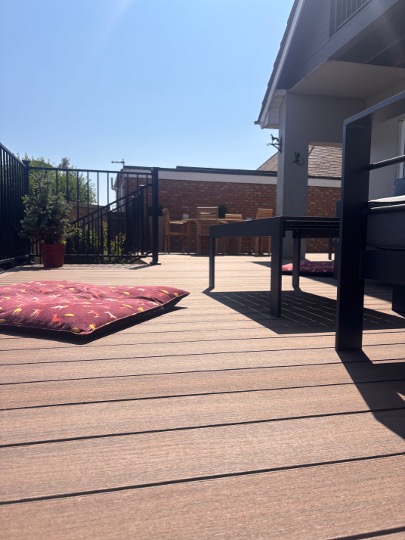
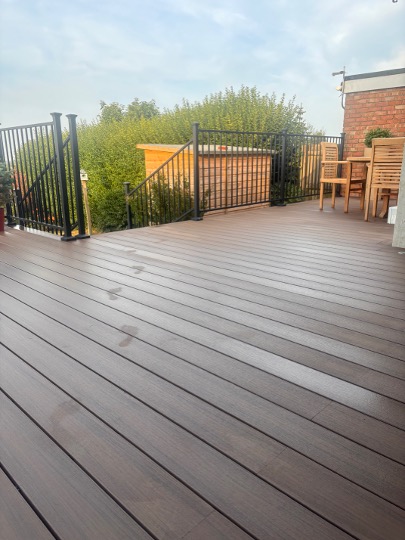
The result combines Deckorators Excursion mineral-based composite decking in Bali, black Fortitude steel balustrading from F.H. Brundle, naturally weathered steel detailing and a durable substructure designed specifically for long-term exterior exposure.
There is quite a lot of engineering underneath it.
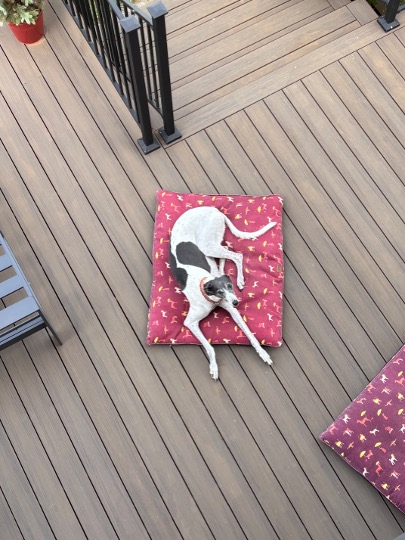
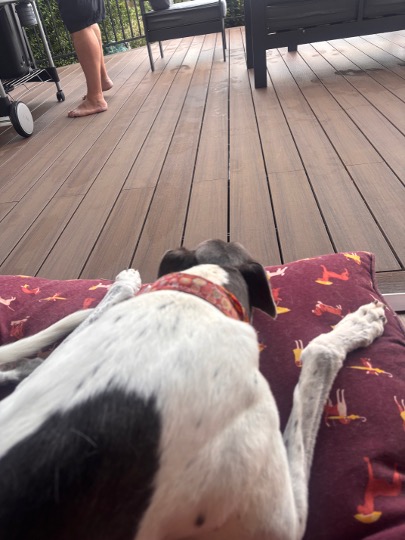
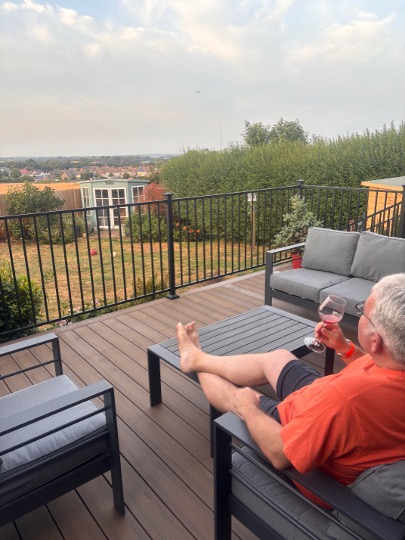
There is also now a barbecue, several chairs, a glass of wine and, rather frequently, a greyhound.
That is probably a fairly good summary of what outdoor living should actually look like.
The main event: Deckorators Excursion in Bali
The main walking surface is Deckorators Excursion in Bali, a mineral-based composite decking board manufactured using Deckorators Surestone technology.
It is a fundamentally different material from the conventional wood-plastic composites many people associate with composite decking. Rather than relying on wood fibre mixed with plastic, Surestone combines polymers with mineral content and contains no organic wood material.
The result is a surprisingly lightweight board with excellent dimensional stability, extremely low moisture absorption and a surface that feels noticeably solid underfoot.
And underfoot matters.
A deck is not something you simply stand back and admire. You walk across it barefoot, drag furniture around on it, carry drinks across it, barbecue on it, let the dogs occupy it and occasionally leave an impressive trail of wet footprints across it.
The photographs from this project demonstrate that last point rather well.
Grip when the weather does what British weather does
Excursion has a pronounced vertical-grain surface intended to increase traction, and Deckorators markets the board as providing 34% more traction in wet conditions.
More importantly, there is published laboratory evidence behind the wider Surestone platform.
Deckorators’ current material-property data records slip-resistance coefficients of 0.73 in dry conditions and 0.66 in wet conditions when tested using ASTM F1679.
Separate independent testing of Deckorators Voyage, which uses the same Surestone mineral-based technology, achieved a P5 wet classification under AS 4586 Appendix A using Slider 55 rubber. P5 is the highest classification within that particular wet pendulum classification system.
I have not seen a published BS 7976 UK Pendulum Test Value for Excursion, so I would rather quote the actual test data that exists than manufacture a British PTV that does not.
Given how often it rained during this build, good wet-weather traction felt less like a marketing feature and more like a personal favour.
Very little movement for a 4.88 metre board
One of the features I particularly value as an installer is the very low thermal movement of Surestone decking.
All materials move as temperature changes. The important question is how much.
Traditional composite and PVC decking can expand and contract noticeably across long lengths, which means installers need to allow fairly substantial end gaps and carefully consider board layout, butt joints and fixed points.
Surestone behaves very differently.
Deckorators publishes a coefficient of linear thermal expansion of 9.4 × 10⁻⁶ in/in/°F for its Surestone Voyage and Summit boards when tested to ASTM D696.
Using that published coefficient, a 4.88 metre board subjected to a temperature change from −10°C to +35°C, a 45°C temperature range, produces a calculated longitudinal dimensional change of approximately 3.7 mm.
Put another way, across almost five metres of decking and a fairly brutal 45-degree temperature swing, we are talking about only a few millimetres of movement.
That is one of the reasons these boards can produce such clean, controlled detailing compared with decking products that move considerably more as temperatures change.
Deckorators describes Surestone as having virtually no thermal expansion or contraction and identifies it as having the lowest thermal expansion and contraction of the thermoplastic decking products in its comparative literature.
That does not mean you ignore expansion gaps or installation instructions. Quite the opposite. Every board on this project was installed strictly in accordance with the manufacturer’s requirements.
Good material deserves good installation.
Comfortable in the sun
Surestone also incorporates heat-mitigating characteristics.
Deckorators describes the surface as barefoot friendly and designed to reduce heat build-up, while the UK Excursion literature refers to a reflective cap that reduces surface heat for a cooler board feel.
No decking surface remains magically cold when it sits in strong summer sun, and I would never claim otherwise.
What matters is reducing unnecessary heat gain and creating a surface that remains more comfortable to use.
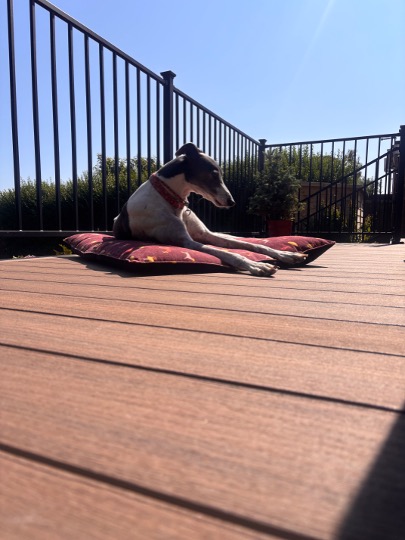
The fact that this deck is regularly occupied by bare feet and long-legged dogs is probably a useful real-world endorsement.
The structure underneath matters just as much
A premium decking board is only as good as the structure supporting it, so considerable thought went into the parts of this project that nobody will notice once the furniture is in place.
The support system incorporates HDPE recycled-plastic posts set into concrete, avoiding conventional timber posts within the critical ground-contact locations.
These support the structural beam arrangement, with principal connections formed using M12 fixings appropriate for exterior Service Class 3 exposure.
Protective decking tape was also applied across the upper faces of the structural members before the decking boards were installed.
It is not glamorous.
It will never get as many photographs as the finished decking.
But these are precisely the details that help determine whether a deck still performs properly many years after the Instagram photographs have disappeared down everyone’s feed.
Fortitude around the edges
The black steel balustrading is F.H. Brundle’s Fortitude Traditional system.
I have used Fortitude for years because it manages to combine three things that do not always arrive together: it is simple, it looks good and it represents excellent value.
The pre-welded panels and adjustable raking sections also make it extremely practical on a project such as this, where the balustrade needs to continue neatly around the main deck and then follow the staircase between levels.
Most importantly, it is a genuine barrier system rather than something selected purely because it looks attractive.
F.H. Brundle confirms that Fortitude Traditional has been rigorously tested to BS 6180, and the company identifies the system as Part K compliant when used within the appropriate installation parameters.
On a raised deck, that distinction matters.
The balustrade is not decoration.
It is part of the safety system.
It just happens to look rather good while doing it.
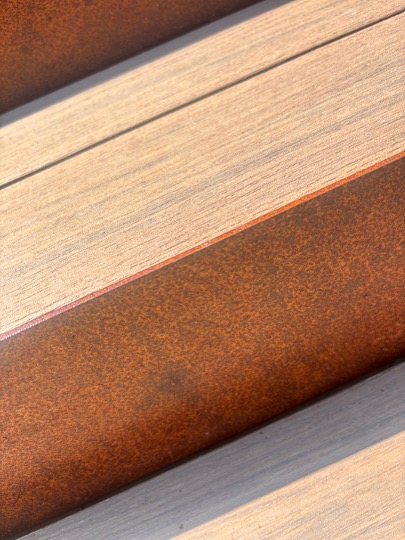
Steel that was supposed to rust
The perimeter details and step upstands introduce another material entirely.
These were formed in steel and deliberately allowed to weather naturally rather than being immediately painted or hidden beneath a pristine coating.
As the steel oxidised, it developed the deep orange and brown patina visible in the photographs, providing a strong contrast with the controlled black balustrade and warm Bali decking.
Once the appearance had developed sufficiently, the steel was treated with Owatrol Oil.
Owatrol Oil is a highly penetrating air-drying rust inhibitor. Rather than sitting on the surface like a conventional decorative clear coat, it penetrates through the rust towards the sound metal beneath, displacing moisture and air and helping to stabilise the oxidised surface.
It therefore allows us to retain the character of naturally weathered steel while giving the surface considerably greater protection.
Rust, in this instance, was not a defect.
It was very much invited.
The balcony gets the same treatment
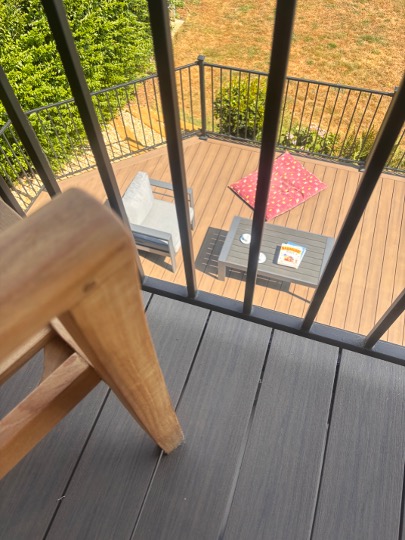
The upper balcony uses the same Deckorators Excursion Bali decking, which helps visually connect the two levels of the project.
Stand upstairs and you look through the balustrading, over the lower decking platform, through the garden and towards the horizon beyond.
Move downstairs and the balcony becomes part of the architecture framing the larger deck.
Using the same board throughout prevents the two areas from feeling like separate projects completed at different times.
Instead, the whole scheme reads as one outdoor living space spread across two levels.
Then the greyhounds arrived
The owners love greyhounds.
Apparently the greyhounds also love Deckorators.
We did not conduct a formal canine approval process, but the methodology appears to involve locating the largest available cushion, placing it in the sun and then occupying it for as many consecutive hours as possible.
The findings have so far been overwhelmingly positive.
Long legs, warm sunshine and a comfortable deck appear to be a successful combination.
It is also rather satisfying to spend considerable time discussing structural loading, thermal coefficients, slip resistance and Service Class 3 fixings, only for the finished project’s most enthusiastic critic to wander outside, turn around twice and go to sleep.
Perhaps that is the better test.
And eventually, the rain stopped
Once construction finished, something remarkable happened.
The sun came out.
The furniture appeared.
The barbecue came onto the deck.
The cushions came outside.
The dogs claimed their preferred positions.
And somebody poured a glass of red wine.
At that point the project stopped being a construction exercise and started becoming what it was designed to be in the first place.
A place to live.
A properly designed deck should survive rain, sun, dogs, bare feet, furniture, food, drink and the occasional less-than-perfect British summer.
It should look good, certainly.
But more importantly, it should invite you outside.
This one does.
See more of our decking projects, materials and design work at Decking by Karl
From technically demanding raised decks to simple outdoor platforms, we design decking to look right, feel right and perform properly for the long term.
Click here to visit Decking by KarlTechnical references
Deckorators Excursion UK product information: Surestone mineral-based composite technology, 34% greater wet traction, low thermal movement and heat-control characteristics.
Deckorators 2026 Surestone material-property data: coefficient of thermal expansion tested to ASTM D696; ASTM F1679 slip-resistance results of 0.73 dry and 0.66 wet.
BRANZ Appraisal 1269: Deckorators Voyage tested to AS 4586 Appendix A with Slider 55 rubber and achieving wet classification P5.
F.H. Brundle Fortitude Traditional: tested to BS 6180; system identified by F.H. Brundle as Part K compliant within the applicable installation conditions.
Owatrol Oil technical data: penetrating air-drying rust inhibitor designed to drive out moisture and air, penetrate rust and protect the sound metal beneath.