“Some stories start with a drawing. This one started in a basement.”
During a major roof terrace project at Paddington Green college campus in London, Karl Harrison was taken on a brief detour. Down in the bowels of the building, stacked quietly against a wall, sat a cache of heavy, honey-brown boards: 40 mm thick and 225 mm wide. Old, solid and far too beautiful to be forgotten.
No-one was quite sure what to do with them. “They’re from the original building,” Karl was told. The previous structure on the site dated back to the early 20th century, so this Iroko was likely pushing a century old. For the moment, it stayed where it was – but the seed had been planted. If you consider that the trees that this timber came from would have been at the very least 200-300 years old. Given the age of the timber from when it was first installed these timbers are in the region of 400 years old…
What is Iroko – and why does it matter?
Iroko is a West African hardwood often described as a “teak alternative”. It is:
- The botanical species name is
- Naturally durable and resistant to decay
- Dense, stable and ideal for exterior use
- Rich in colour, with a warm golden-brown tone that deepens over time
In the past it was widely used in civic buildings, joinery and exterior structures. Today, sourcing new tropical hardwood is a sensitive subject. So, when you have historic Iroko already in the building, the most sustainable thing you can do is not throw it away – you upcycle it.
That is where this project becomes more than just furniture. It becomes a quiet act of conservation and circular design.
From forgotten boards to a design brief
Months after the roof terraces were completed, the college management team contacted Karl again. They loved the new outdoor spaces, but they felt bare. Could he design and install bench–table furniture so students and staff could use the terraces?
That basement visit came straight back to mind.
Rather than specifying new materials, Karl proposed something more interesting:
- Source robust steel table frames for long-term structural stability
- Reclaim the old Iroko from storage
- Transform it into a suite of bespoke bench tables for the terraces
Sustainability, heritage and contemporary use, all stitched together in one move.
The making: careful, hands-on and very dusty
Once the proposal was approved, the team at Karl Harrison Landscapes got to work. This was not a simple “cut to length and screw down” job. The timber had history – and imperfections – that needed respect and skill.
The process included:
- Measuring and setting out each board to minimise waste
- Machining and cutting to achieve clean, consistent dimensions
- Routing edges to soften touch points and give a finished, tactile feel
- Deep sanding to remove decades of grime while keeping the character
- Oiling with exterior-grade finishes to nourish and protect the grain
- Owatrol is a trusted brand of timber coatings, Aquadecks was used to great effect.
All of this was done in-house, by tradespeople who understand both carpentry and landscape construction. Within a month, the raw boards had been reborn as 20 solid Iroko bench tables.
New furniture with an old soul
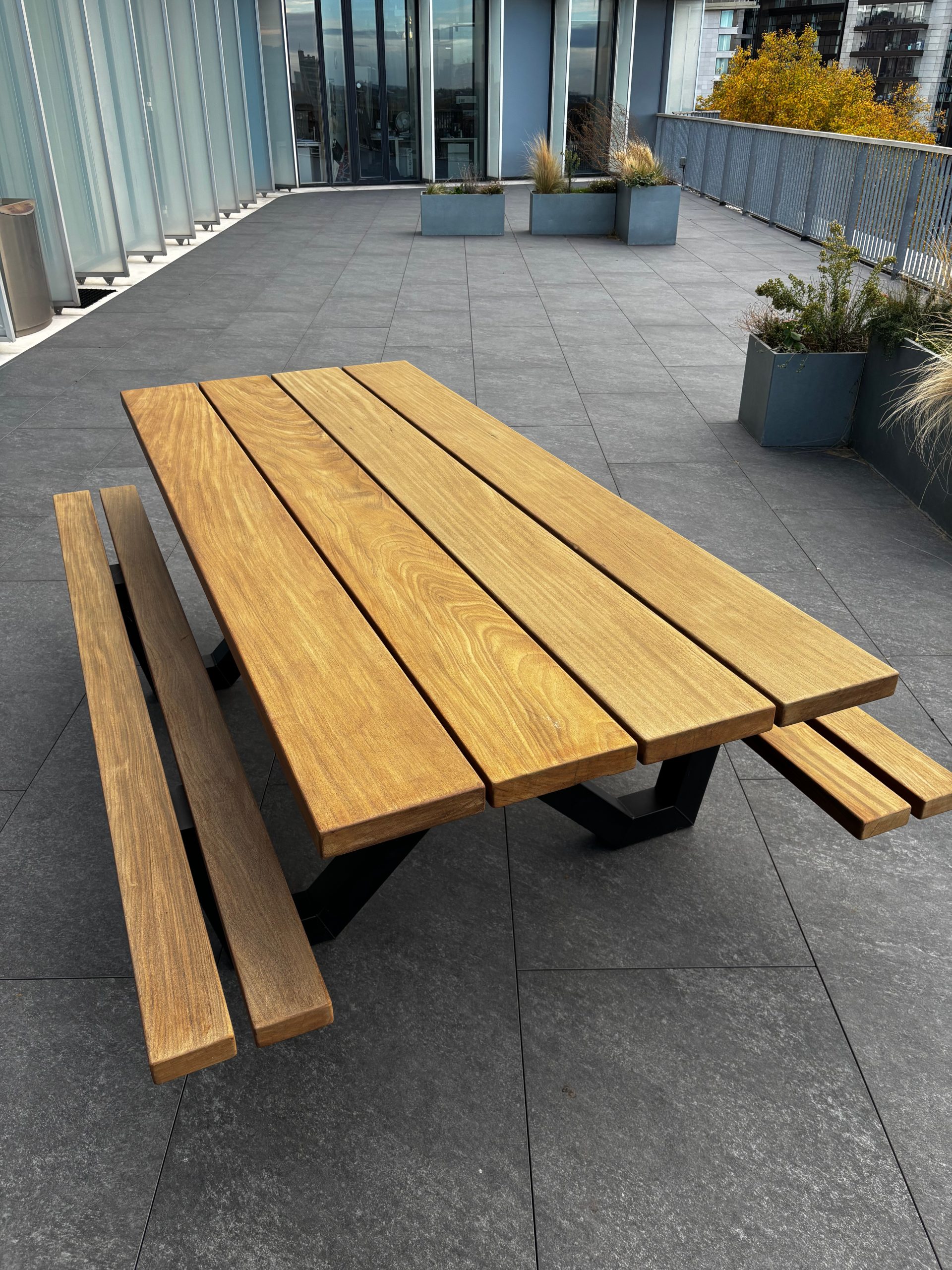
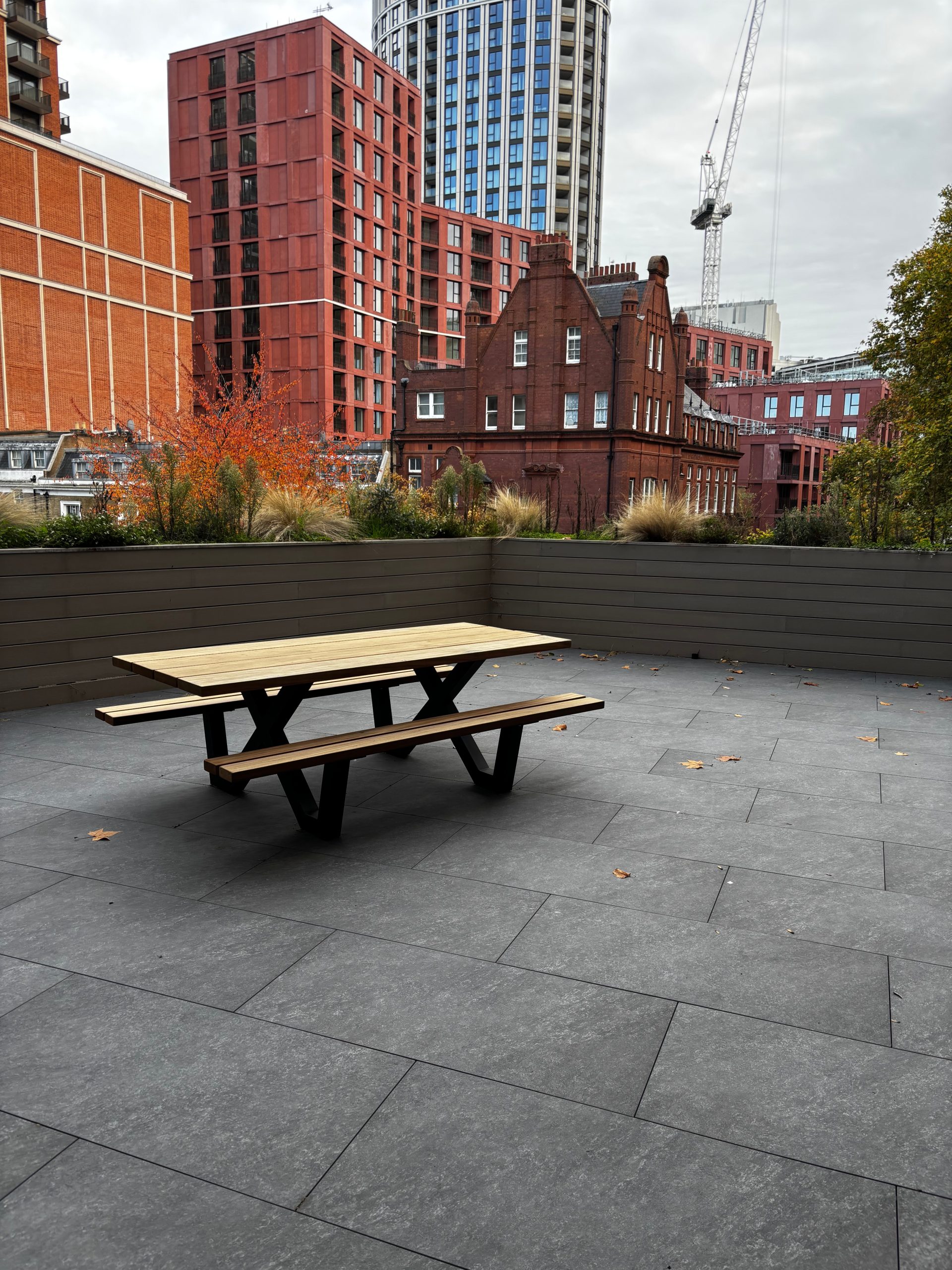
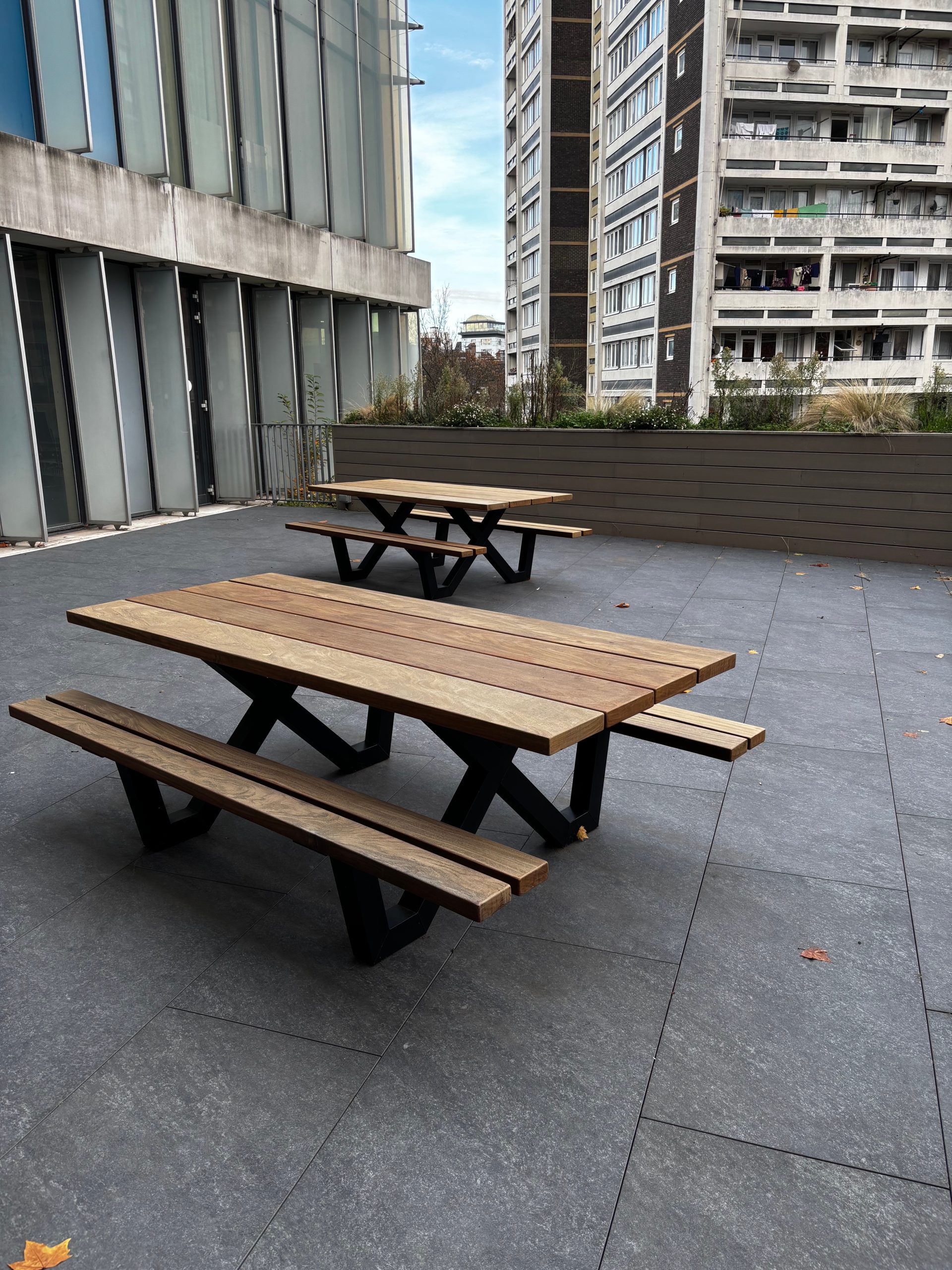
Installed on the roof terraces, the finished pieces feel right at home. The dark steel frames give a contemporary, almost industrial line that suits the college architecture. The Iroko tops bring warmth, texture and a subtle sense of history.
Students now lean on timber that may have once been part of the original building fabric. The material stays on site, but its role has changed completely – from structure to social space. That is upcycling at its best: no nostalgia, just intelligent reuse.
The result is:
- Hard-wearing, low-maintenance outdoor furniture
- A strong sustainability story for the college
- A visual link between old Paddington Green and its current campus life
Sustainability in practice, not just on paper
This project quietly ticks a lot of ecological and sustainable design boxes:
- Re-use over replacement: No new tropical hardwood was imported. Existing Iroko was recovered and reimagined.
- Reduced waste: Careful set-out meant most boards were fully utilised, with offcuts designed into smaller elements where possible.
- Longevity: Iroko’s natural durability and the robust frames mean these tables should serve the college community for many years.
It shows that sustainability is not just about new “eco materials”. Sometimes the greenest option is to look under your feet and ask: what do we already have, and how can we make it brilliant again?
Why choose Karl Harrison for upcycled outdoor design?
Projects like this are where design, craftsmanship and sustainability genuinely meet.
As a London-based Garden and decking designer, Karl Harrison specialises in:
- Complex terraces, roof gardens and outdoor platforms
- Intelligent use of materials, including reclaimed hardwoods
- Detailed, buildable designs backed by experienced site teams
From first survey to final installation at Paddington Green, Karl and his team handled the entire process. From concept, sourcing, fabrication and fit-out. The result is a set of roof terraces that are not only attractive and practical but also rooted in the story of the building itself.
Thinking about upcycling in your own project?
Do you have an existing structure, store of old timber or a building. Does it have a hidden history, there may be a smarter way to furnish your outdoor spaces.
Karl Harrison Design can help you:
- Assess what can be reused
- Design bespoke furniture or decking around reclaimed materials
- Deliver a finished scheme that feels fresh, considered and sustainable
When vintage timber is given a second life in a new landscape. Everyone wins – the client, the building, and the environment.